






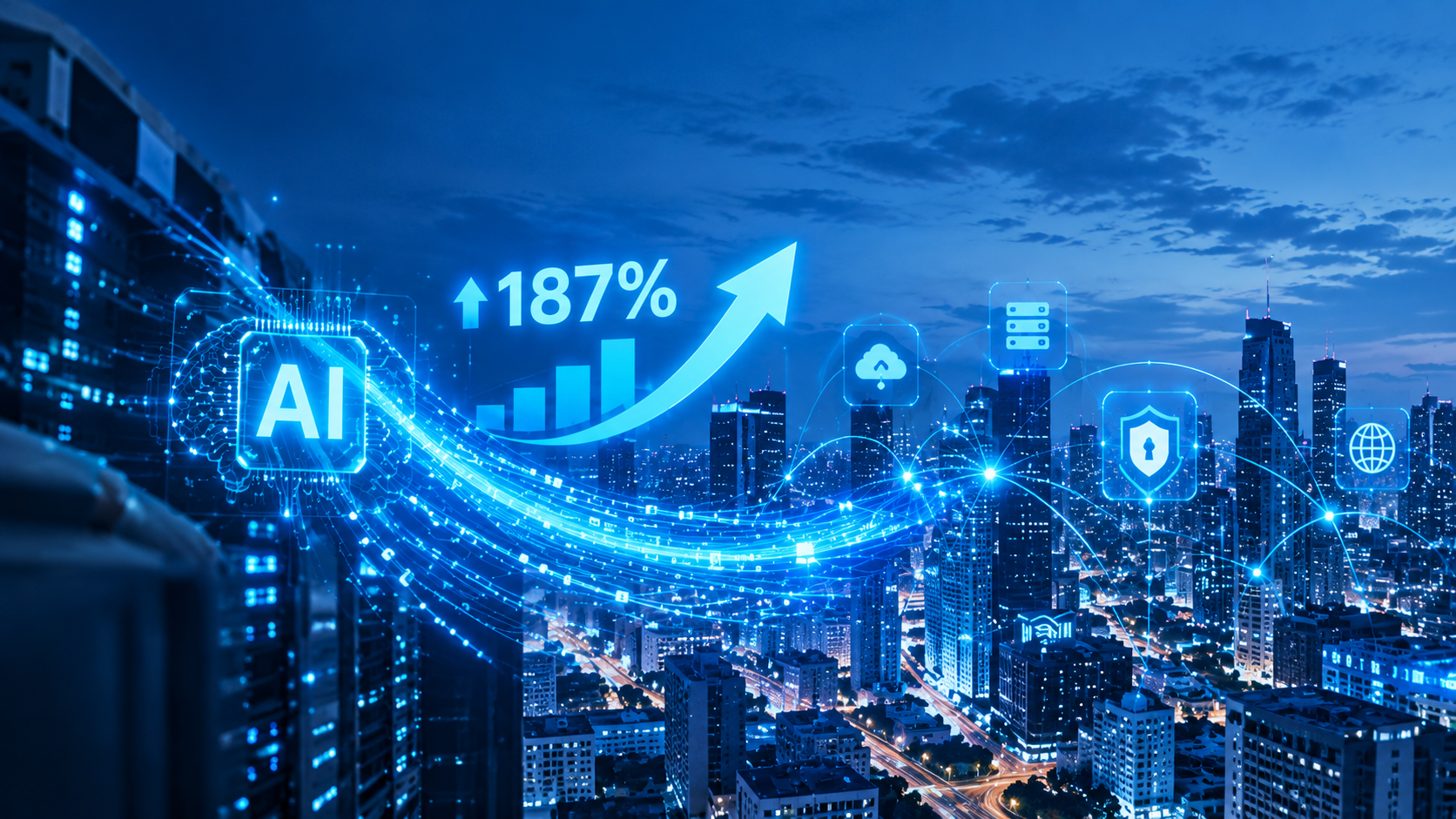
AI Traffic Increased by 187%: Is Your Network and Security Ready for the Rise of AI?
- Technology
-

By admin
- Sep 16, 2026
- 8 Views
Artificial Intelligence (AI) is no longer limited to answering questions, generating content, or assisting with everyday tasks. AI is becoming increasingly active in interacting with digital services, accessing information, and performing processes automatically. As a result, the way data moves across networks is also changing, creating new considerations for businesses.
According to the HUMAN Security 2026 State of AI Traffic & Cyberthreat Benchmark Report, monthly AI-driven traffic increased by 187% between January and December 2025, nearly tripling over the course of the year. During the same period, traffic from AI agents and agentic browsers grew by 7,851% year-over-year.
This growth shows that the impact of AI goes beyond the applications people use. It is also changing how devices, applications, and digital systems communicate across networks. For businesses, this raises an important question:
are existing network infrastructure and security systems ready to handle this shift?
AI Is Changing the Way Traffic Moves
For years, most digital activity has been designed around humans as the primary users. People visit websites, access applications, search for information, and take actions based on what they find.
That pattern is beginning to change. AI-driven systems can now access information and perform digital activities automatically. AI agents, for example, can help search for products, compare information, access accounts, and perform certain tasks on behalf of users. HUMAN Security reported significant growth in traffic from AI agents and agentic browsers throughout 2025, highlighting a new form of interaction between AI and digital services.
This means network traffic can no longer be viewed simply as communication between people and applications. Businesses also need to consider interactions between AI systems, applications, servers, and digital services.
As these interactions become more common, network visibility, monitoring, and infrastructure planning become increasingly important.
Growing AI Traffic Requires More Scalable Infrastructure
An increase in traffic does not simply mean that businesses need more bandwidth. As communication patterns become more complex, networks also need to provide reliable connectivity, appropriate latency, and enough capacity to support growing workloads.
Cisco estimates that the adoption of AI and agentic AI could increase consumer-driven network traffic by approximately 6.6 times by 2035. In enterprise networks, traffic could grow by around 9 times under scenarios involving agentic AI adoption. Cisco also estimates that around 70% of traffic in AI agent workflows could be related to AI inference, making connectivity an important factor in maintaining AI performance.
For businesses, network readiness therefore needs to go beyond current capacity. Infrastructure should also be able to scale as digital workloads and AI adoption continue to evolve.
Key considerations include:
- Network visibility to understand traffic patterns more clearly.
- Real-time monitoring to identify changes in network conditions quickly.
- Scalable infrastructure to support growing workloads and traffic.
- Reliable connectivity to maintain stable access to applications and services.
- Performance monitoring to identify potential bottlenecks before they affect operations.
More AI Traffic Means Greater Security Considerations
The growth of AI-driven traffic also introduces new challenges for cybersecurity. Not every automated activity is malicious, but not every automated request can automatically be considered safe either.
AI agents and automated systems can interact with product pages, user accounts, authentication flows, and transaction processes. At the same time, these areas can also become targets for malicious activity. HUMAN Security reported that median global traffic associated with scraping attempts approached 20% in 2025, while post-login account compromise attempts increased more than fourfold year-over-year.
This makes network security increasingly complex. Security systems need to understand who or what is generating traffic, how that traffic behaves, and whether the activity matches expected patterns.
In other words, network security can no longer rely solely on a simple distinction between “human” and “bot” traffic. As legitimate AI agents become more common, automated traffic does not necessarily indicate a threat. HUMAN Security also highlights the growing difficulty of distinguishing legitimate automation from malicious activity based on behavior alone.
From Network Monitoring to Network Intelligence
As the digital environment changes, businesses need more than a fast and reliable network. They need visibility, monitoring, and actionable insights to understand what is happening across their infrastructure.
Network monitoring can provide real-time visibility into device performance, connectivity, and network conditions. When combined with effective data analysis, this information can help identify patterns, detect anomalies, and support teams in prioritizing issues before they become larger operational problems.
This creates a more proactive approach to network management. Instead of responding only after a disruption occurs, businesses can use monitoring data to identify performance changes and take action earlier.
Ultimately, preparing for the growth of AI is not simply about how much network capacity a business has. It is also about how effectively that business can understand, monitor, secure, and manage the traffic moving across its infrastructure.
Is Your Infrastructure Ready for the AI Era?
The rapid growth of AI-driven traffic shows that the digital environment is entering a new phase. AI is no longer simply an application used by people. It is increasingly becoming part of how digital services interact, exchange data, and perform tasks.
For businesses, this is an opportunity to reassess their network infrastructure, network monitoring, and security strategy. Scalable infrastructure, real-time visibility, and security solutions capable of understanding different types of traffic will become increasingly important as the digital ecosystem continues to evolve.
At SOLU, we help businesses build connected and reliable technology infrastructure designed around real operational needs. From network monitoring to integrated digital solutions, the right infrastructure can help organizations gain better visibility, respond faster, and stay ready for what comes next.
Share:
Request A Call Back
Your next big leap starts with a simple conversation, let's sparks the next big idea together
